
In our spiritual journey, we often encounter words in the Bible that act as thin veils, hiding profound divine mysteries. One such word is Gilgal.
Too often, we read the Scriptures as mere history, racing past the old names and places to get to the story’s action. But if we slow down and listen with our hearts, we discover that Gilgal is not just an ancient, dusty campsite on a faded map. It is a spiritual sanctuary designed for you. It is the sacred space where God meets us to untether us from the shame of our past systematically.
Remembrance: Resting Before the Battle
To truly sit with this story, let’s look at how it begins. After a long, exhausting journey crossing the Jordan River on dry ground, Joshua commanded the people to do something unusual. He told twelve men to pull twelve massive stones directly from the middle of the dry riverbed and pile them up at their new camp. They called this place Gilgal.
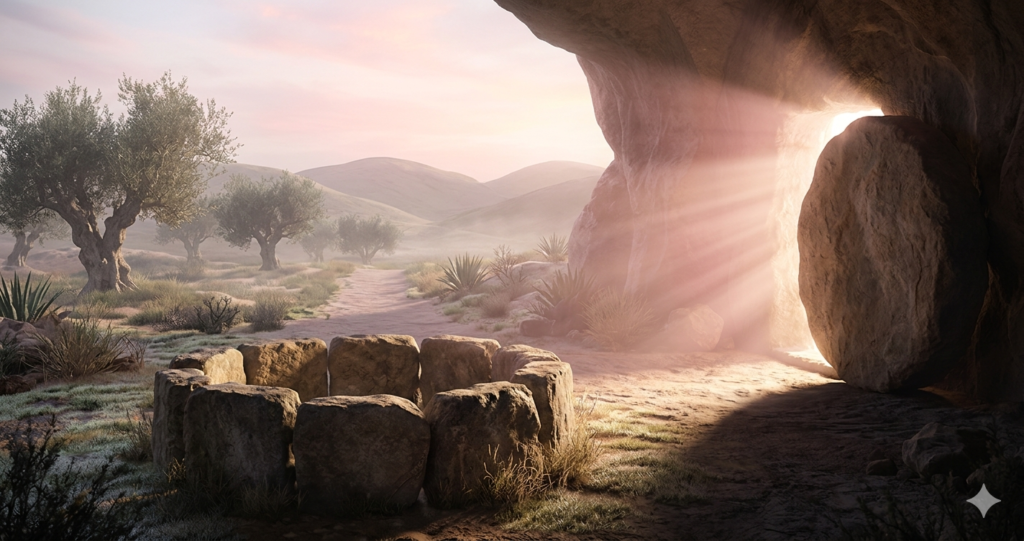
In the original language of the Old Testament, the name Gilgal springs from a beautiful word meaning “to roll” or “to move in a circle.” It literally translates to a “circle of stones.” Imagine standing inside that quiet circle. Each stone was a physical whisper of a miracle just witnessed. Before Israel was allowed to face the walls of Jericho, God anchored them right there in that circle of remembrance.
A Moment for Reflection: How often do we rush blindly into our next battle, or spiral into a new season of anxiety, completely forgetting the deep rivers God has already parted for us? Gilgal invites you to hit the pause button. Before you try to fight tomorrow’s battles, step into the circle of your past victories. Count the stones of God’s faithfulness in your life. Let the memory of His past goodness quiet your present fear.
The Sanctuary of Consecration: The Pain That Heals
As we look closer at what happened at the camp, the story takes a deeply intimate, challenging turn. Before a single sword is drawn against Jericho, God gives a startling command: the entire generation of men must be circumcised.
From a human standpoint, this made absolutely no sense. It was scary. They were deep in enemy territory, right on the doorstep of their enemies, and this action would leave the entire army completely vulnerable and unable to fight for days. Why would God demand this now?
The truth is, the generation that grew up wandering in the desert had neglected this sign of God’s covenant. They were finally standing in the Promised Land, but they were still living with the old habits.
Gilgal reminds us that God cares far more about our relationship with Him than our strategies for success. We often cry out for instant victory over the giant “Jerichos” in our lives, but God is gently whispering, “Come to Gilgal first.” Gilgal is a place of painful, beautiful surrender. It is where we allow the Holy Spirit to cut away the compromised habits, the self-reliance, and the hidden idols we carried through our dry seasons. It reminds us that true spiritual breakthrough requires us to be vulnerable before God before we can ever be victorious before the world. Trust the pain of His pruning; it is always preparing you for His promise.
Pronouncement: Your Shame is Rolled Away
The ultimate of this story, and the heartbeat of God’s message for you today, breaks forth in a beautiful promise. In Joshua 5:9, the Lord speaks directly to Joshua:
“Today I have rolled away the reproach of Egypt from you.”
God is making a beautiful play on words here. Gilgal—the place of the circle—becomes the permanent monument of the “rolling away.” Think about what the “reproach of Egypt” really meant. For forty long years in the desert, the Israelites were physically free, yet they still carried the psychological identity of slaves. They could still feel the phantom sting of the taskmasters’ whips in their memories. They still believed the lies that they were unworthy, abandoned, and defined by their past captivity. They had left Egypt, but Egypt hadn’t left them.
But at Gilgal, through a quiet celebration of the Passover, God tenderly and completely divorced them from their history.
You can be entirely forgiven by God, yet still live as a captive to your past. You can be rescued, yet still choose to identify with your trauma, your failures, or the negative labels that others have pinned on you.
Listen closely to the whisper of Gilgal today. God is looking directly at your life and declaring, “The shame of what you used to be, the guilt of where you failed, the reproach of your old identity—I am rolling it away right now.” You are no longer defined by the desert you walked through or the captivity you escaped. You are defined by the One who loves you.
Empty Tomb: The Ultimate Gilgal
Every beautiful shadow in the Old Testament eventually leads us directly to the brilliant light of Jesus Christ.
Centuries after Joshua stood at the camp of Gilgal, a group of scholars translated the Hebrew scriptures into Greek. When they translated that specific phrase, “to roll away,” they used a unique Greek word: apokylió.
Centuries later, on a quiet, dew-kissed Sunday morning, that exact same word appears in the resurrection story:
“And they found the stone rolled away (apokekylismenon) from the tomb…” (Luke 24:2).
The ultimate destination of Gilgal finds its true home at the empty tomb of Jesus. That massive stone wasn’t rolled away to let a resurrected Savior out; it was rolled away to invite you to look in. It stands as open proof that your reproach, your sin, your shame, and your past have been conquered forever.
Prayer for Your Journey
Step into your Gilgal today. Bring your weariness, your heavy heart, and your memories into the circle of His remembrance. Surrender your heart afresh to His changing touch. And listen to the definitive voice of the Savior whispering over your soul today:
“The past is gone. The shame is rolled away. Take a deep breath, and walk forward into my promise.”